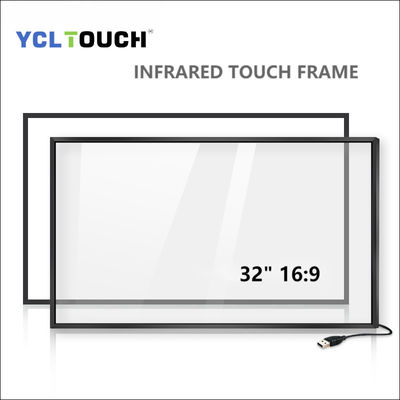
The advantages column
Size without a ceiling. Frames in this catalogue are standard product to 98 inches and supplier-specified to 500. No competing technology prices a 3-metre touch surface without a negotiation. Any touching object. Gloves, styli, prosthetics, a pen that ran out of battery — the grid senses interruption, not conductivity. Industrial and clinical buyers treat this as the headline, not a footnote. Optical purity. Nothing sits between the panel and the viewer: no film haze, no mesh pattern, no brightness tax. The display you bought is the display you see. A replaceable wear surface. The sacrificial layer is plain glass or acrylic that you choose and can replace; the sensor does not wear at all. In amusement and public duty, where surfaces die young, this is an operating-cost argument. Retrofit economics. The frame mounts on the display you already own — the TV overlay pattern — so the expensive asset (the panel) is not re-bought to gain touch. Single-cable simplicity. USB carries data and 5V power; the retrofit adds one lead.
The disadvantages column
The bezel lip. A frame stands proud of the glass by its profile depth. Flush-glass product design cannot accept it; that brief belongs to PCAP panels. Sunlight. Direct sun on the sensing field is infrared's genuine adversary. Mitigations exist; physics remains. Sun-exposed installs need shading or another technology. The open sensing plane. Anything crossing the plane registers — sleeves, insects, a leaning lanyard. Interfaces for IR installs must be designed with deliberate targets, a point our installation guide repeats until it bores us both. No pressure or palm semantics. The grid reports position, not force, and cannot distinguish a resting palm by material. Software palm-rejection by size and shape is good and improving, but a palm is, to the sensor, a wide finger. Resolution is interpolated. The 32768 × 32768 figure is a coordinate space, not a beam census — accurate in practice after calibration, but buyers should know what the number is, as our technology page explains.
Costs: the column nobody prints
At small sizes, IR frames and PCAP panels price within sight of each other, and PCAP usually wins the whole-brief comparison once the glass is counted. The crossover sits around 30 inches; by 55 inches an IR frame commonly costs a fraction of any capacitive alternative of the same area, and beyond 86 inches there is no capacitive quote to compare against at all. Total cost should also count the display strategy: an overlay programme lets a fleet keep its panels and standardise only the touch layer — the arithmetic behind the large format business case.
So, the selection rule
Choose infrared when size, gloves, retrofitting or surface replacement dominate the brief. Choose PCAP when flush glass, small size or product integration dominates. Choose foil when the touch must hide behind an architectural glass pane. If your brief mixes the columns — it usually does — send it through the inquiry form with the environment described; an honest specification is the only deliverable we are interested in shipping.
Two scenarios where the ledger flips
Ledgers are honest only when they survive contact with scenarios, so here are the two that most often reverse a first-draft decision. Scenario one: the outdoor-adjacent kiosk. The first draft says infrared — gloves, size, retrofit. Then someone mentions the kiosk faces a glass façade with afternoon sun raking across it. The sunlight row, a minor line in the disadvantages column, becomes the deciding row: the specification flips to a shaded repositioning of the terminal, or to foil behind the façade glass, or the project accepts an awning as part of the touch budget. The technology did not change; its environment row promoted itself. Scenario two: the sealed medical-adjacent terminal. The first draft says PCAP — flush glass, cleanability. Then the cleaning protocol arrives: aggressive agents, daily, by staff who will not baby a coating. The surface row flips the decision toward an infrared frame behind a sacrificial, replaceable glass pane — the sensor never meets the chemistry at all. Both scenarios teach the same lesson the ledger exists to teach: no column wins in the abstract. The environment gets a vote, and it usually casts the deciding one. Bring the environment — sun path, cleaning regime, glove policy, vandalism exposure — into the first conversation, and the ledger stops being a debate format and becomes what it should be: a specification.
Maintenance and lifetime: the quiet columns
Two more rows belong in any honest ledger, because they compound over years. Maintenance burden. Infrared asks for a cloth along the frame's window strips on a schedule set by dust; PCAP asks for nothing until its surface is damaged, at which point it asks for a panel. Foil asks for nothing at all until the glass refit. Over a five-year public installation, the infrared row is a rota; the PCAP row is a spare-parts budget; both are manageable, but they are different departments' money and should be planned by the right one. Lifetime mismatch. Displays age faster than touch programmes: panels dim, resolutions date, operating systems retire. An overlay estate re-uses its touch investment across display generations by re-drawing a frame; an integrated panel estate replaces touch and display together, at display prices, on display schedules. Committees modelling five-year cost should model the refresh honestly — it is the row where retrofit architectures repay their bezel lip many times over. Add environment, maintenance and lifetime to the four selection variables in the main article and the ledger stops being a comparison of technologies and becomes what a specification should be: an account of your installation's actual life.
The bottom line
Infrared touch is neither the universal answer its vendors claim nor the legacy technology its rivals describe. It is the correct engineering choice for a specific, large and growing set of briefs — big surfaces, gloved users, retrofits, replaceable wear layers — and the wrong choice for another specific set that this page has named just as plainly. Specification is the discipline of matching the two sets to your brief before money moves. If, after this ledger, your brief still straddles the line, that is normal: send it in with the environment described, and let the specification conversation — the one this whole site is organised around — do its work.
One more practical consequence of the ledger deserves emphasis, because it decides budgets: the columns interact. Choosing infrared for its size range also chooses its maintenance rota and its sunlight constraint; choosing PCAP for its flush surface also chooses its size ceiling and its replacement economics. There is no configuration in which a project picks only advantages from both columns, and vendors who imply otherwise are selling the interaction away. The mature specification names the interactions explicitly — "we accept the bezel lip in exchange for the size ladder; we accept the cleaning rota in exchange for the replaceable surface" — and records them in the project file where the next decision-maker can find them. Technologies do not fail projects; unrecorded trade-offs do, usually in the second year, when the person who understood the exchange has moved on. Write the exchange down.