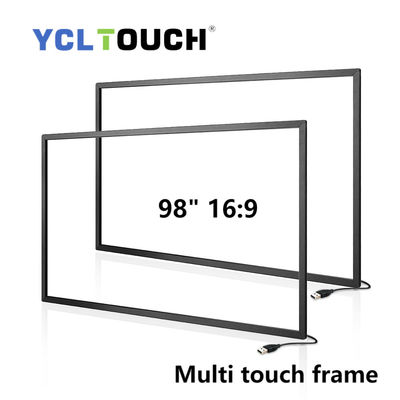
A definition that fits in one sentence
An infrared touch screen is a display surrounded by a frame that projects a grid of invisible infrared light beams across its surface; when something breaks the beams, the system knows where. There is no touch-sensitive coating on the glass, no film to scratch through, and nothing between the user's eye and the picture except the display's own cover. Our technology page on how infrared touch works covers the engineering in depth; this article is the buyer's version.
The mechanism, step by step
Inside two adjacent edges of the frame sit infrared LEDs, firing across the surface. On the two opposite edges sit photoreceptors, watching for their light. At rest, every receptor sees its beam. When a finger enters the plane — a few millimetres above the glass — it blocks a cluster of beams on the X axis and another on the Y axis. The controller samples the occlusion pattern hundreds of times per second, computes the centre of each blocked cluster, and reports coordinates. Because occlusion is partial at the edges of a fingertip, the controller interpolates between beams; that is how a frame with a physical beam pitch of several millimetres reports the catalogue's 32768 × 32768 coordinate resolution honestly. The touch object never has to conduct electricity, carry a battery, or even be a finger: gloves, styli, a rolled-up worksheet and a coffee cup all register, which is the technology's defining operational trait.
Where the idea came from — and why it survived
Infrared touch predates the capacitive era by decades; early systems guarded cash machines and information kiosks when resistive film was the only alternative. It survived the smartphone revolution not by competing for pockets but by owning the territory phones cannot enter: size. A capacitive sensor's cost grows with area and channel count together. An infrared frame's cost grows with perimeter. So the frame programme in this catalogue runs from 15 inches to a supplier-specified 500 inches, while the PCAP range — excellent technology, wrong curve — ends at 27. Every "interactive wall" you have ever touched was, underneath, almost certainly infrared.
Multi-touch on a light grid
Sceptics ask how a single light plane separates ten fingers. Two touches on a grid naively suggest four candidate points (the two real ones and two ghosts). Frame controllers resolve the ambiguity by continuity: they track each touch blob as it appears, moves and lifts, at millisecond-class scan rates, so ghosts never acquire a history. Modern frames in this catalogue track 10 points on compact models, 20 as the large-frame standard, and the platform is specified to 64. What that means per application is worked out in our guide to touch points.
Behaviour in the real world
Sunlight. Sunlight contains infrared, and a sensing field in direct sun can saturate. Quality frames modulate their beams and filter aggressively, but the honest guidance stands: shade the install or choose another technology for sun-drenched surfaces. Dirt. Dust dims beams gradually rather than failing suddenly; a wipe of the frame's inner window strips is the whole maintenance regime. Damage. The sensing surface is the display's own glass or your protective pane — sacrificial and replaceable — while the electronics live in the frame profile, serviceable as components. Latency. Listed response runs from 10 ms class down to under 8 ms on selected frames: fast enough that pen lag is a software question, not a sensor one.
When infrared is the wrong answer
When the product must be a flush sheet of glass; when the device is handheld; when the front must seal to an ingress rating by itself; when the users and the aesthetic both demand phone-like glass. Those briefs belong to PCAP panels and touch foil, and this site sells those too — the IR vs PCAP comparison exists because we would rather lose a frame sale than fund a return. But when the brief is a wall, a classroom, a kiosk fleet or a table that seats four, infrared is not the legacy option. It is the engineering answer.
A worked example: specifying a classroom wall
Abstract mechanisms become clear when a real brief passes through them. Take a school converting a 75-inch television in a standard classroom. The brief: finger writing by the teacher, occasional two-pupil interaction, existing Windows PC, shaded room, tight budget. Infrared answers every line without strain: a 20-point frame sized to the cabinet, USB to the room PC, calibration with the teacher's stylus, done in an afternoon. The same brief sent to a capacitive specification fails at the first line — no PCAP sensor exists at that diagonal at a school budget. Sent to a resistive or optical-camera specification, it survives the size test and fails on multi-touch honesty and surface wear within a year. The point of the example is not that infrared always wins; it is that the mechanism — a perimeter grid with nothing on the glass — is what makes the win structural rather than marginal. Technologies should be chosen the way this brief chooses: variable by variable, with the mechanism in view. The mechanism is also why the maintenance conversation is so short: the sensing plane cannot be scratched because it is not a surface, the electronics sit in a profile a technician can open, and the wear layer is the display's own glass. When a purchasing committee asks what will need replacing in year five, the infrared answer is "possibly a USB lead". Every other technology's answer is longer, and the length is the cost.
Selecting a frame in practice
Knowing the mechanism turns selection into a short interview. What is the diagonal and the cabinet's outer dimensions? What touches it — fingers, gloves, styli, the public? What light falls on it across the day? What computer drives it, and what software must feel native on it? Four answers, and the correct model usually selects itself from the family ladder: compact panels for counters, the 43-inch kit class for terminals and teaching podiums, the 55 and 65-inch frames for rooms, the 82-to-98-inch class for walls, spliced systems beyond. The interview also exposes the briefs infrared should decline — the flush-glass product front, the sun-exposed façade with no shading option — and declining them early is a service, because the cost of a wrong technology is never the unit price; it is the programme built on top of it. Ask the four questions in the inquiry form and the reply you receive will be a specification with reasoning attached, which is the only kind of quotation worth forwarding to a committee.