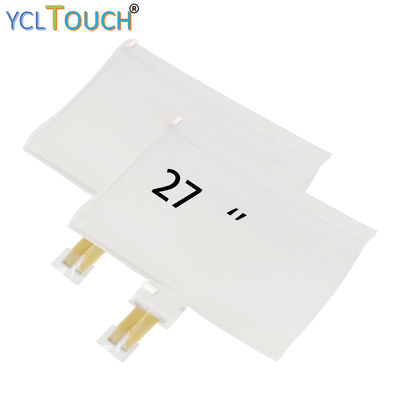
What the film is
Touch screen film — capacitive touch foil — is a transparent projected-capacitive sensor in the form of a flexible sheet. On the listed models in the foil family it is 0.155 mm thick, carries a grid of near-invisible electrodes, and connects to a small controller board with a USB output. You laminate it to the inside face of a glass pane; a display sits behind the glass (or the glass is itself the storefront); a customer's finger on the outside surface couples capacitively through the glass to the electrode grid, and the controller reports a touch. The glass is simultaneously the shop window, the vandal shield and the touch surface.
Why it works through glass — and when it doesn't
Projected capacitive sensing measures tiny changes in an electric field. A finger several millimetres away, separated by glass, still perturbs that field measurably — which is why through-glass operation is possible at all. But the coupling weakens with distance, so glass thickness is the governing specification. Single-pane retail glazing is the routine case. Thick, laminated or multi-layer architectural glass attenuates the signal and must be assessed per project; metalised coatings and some low-e treatments can block the field outright. This is why foil inquiries on this site begin with the glass, not the diagonal: pane construction, thickness, coatings. Anyone who quotes foil without asking about your glass is guessing with your budget.
Installation is lamination
Unlike a frame, foil is not mounted — it is laminated. The glass is cleaned to optical standards, the film is applied wet or dry per the product's process, edges are sealed, and the controller tail is routed to the electronics cavity. Dust or a bubble under the film is a permanent optical defect, so foil installation is a clean-hands, unhurried procedure, closer to window-film craft than to IT work. The permanence is the trade: in exchange for a front with no visible hardware and nothing to unbolt, the foil stays with the glass for life. The foil vs frame guide weighs that exchange directly.
Where foil earns its specification
Retail windows. The canonical application: the display advertises by day; after closing, the window itself takes touches — catalogues, menus, wayfinding — with every electronic asset locked safely inside. Glass partitions and meeting glass. A foil behind a glass wall turns the wall into the control surface without drilling or visible devices. Exhibits and cases. Touch through the case glass keeps artefacts untouched while the interpretation layer becomes interactive. Curved glass. The family lists a flexible curved build (65-inch, with stated dimensions) — a regime frames cannot follow.
Specification checklist
- Glass: thickness, layers, coatings, size of the active area within the pane
- Touch points: 10 standard; a listed 65-inch waterproof build runs to 40
- Transparency expectation: a listed nano-foil model states 85%
- Controller placement and USB routing from the film tail
- Environment: condensation risk on the glass's cold face in storefront duty
Send the glass specification with your inquiry and the reply will state plainly whether foil serves your pane — or whether the honest recommendation is a frame. Both answers are in this catalogue; only one of them is right for your window.
Commissioning and care: the foil in service
Foil installations fail quietly or not at all, and the difference is commissioning discipline. After lamination and controller connection, the surface must be calibrated against the actual content layout — storefront content changes seasonally, and the touch targets should be re-verified against each new layout, because a window that invites a touch three centimetres from the sensor's idea of the button teaches the public that the window does not work. Environmental care is mostly about the glass: condensation forming on the pane's cold face in winter mornings can disturb the field until it clears, which is a building-services fact to plan around (ventilation, heating patterns) rather than a foil defect to warranty. Cleaning is the foil's home advantage — the public side is plain glass and takes ordinary glass cleaning, with the electronics sealed away from every spray bottle. What foil asks in return is respect for its one irreversibility: it cannot be peeled off and reapplied when the shop refits. Programmes that treat the window as a five-year fixture get five quiet years from it; programmes that treat it as a poster get one expensive lesson. Specify it as the fixture it is — in the refit budget, in the lease conversation, in the content plan — and touch through glass becomes the most reliable surface in the building, precisely because there is nothing on the public side to break.
Costs and comparisons a buyer actually faces
Foil's economics confuse buyers because the comparison is rarely like-for-like. Against an infrared frame on the same storefront display, foil adds the lamination labour and the permanence, and removes the visible hardware and the after-hours vulnerability — the window keeps working with the shop locked and dark, which is the entire commercial point for retail. Against replacing the window display with a purpose-built through-glass kiosk, foil is a fraction of the cost and keeps the existing display asset. The honest way to model it is per window per year: film and controller, lamination, content production, and the refit reserve for the day the glass changes. Programmes that cost it that way buy foil with open eyes and keep it for its full life; programmes that cost it as a sticker discover the lamination invoice and the refit clause as surprises. One more comparison belongs in the file: foil versus doing nothing after hours. A dark window earns nothing; an interactive one takes catalogue searches, queue registrations and menu browses all night. For many retailers that arithmetic, not the technology, is the decision — the film is simply how the arithmetic is collected.
One last specification habit
Order foil the way you would order glazing — because that is what it becomes. Record the pane's full build-up in the project file: glass type, thickness, coatings, which face carries the film, and the controller's location. Photograph the lamination before the display goes in behind it. These records cost minutes and save the two conversations foil owners otherwise have in year three: the refit conversation ("what exactly is on our glass?") and the reorder conversation ("can we get the same film for the new unit?"). With the record, both are emails. Without it, both are site surveys. The film itself will not remind you — it is transparent, after all. Your file has to be its memory.
It is worth closing on the user experience, since that is what the film is ultimately for. A through-glass interaction succeeds when the public understands it instantly: the window must look touchable — content that invites a hand, targets sized for a fingertip through glass, feedback immediate enough to confirm the touch landed. The film and controller supply the sensing; the content supplies the invitation, and programmes that budget for content design get the usage their hardware deserves. A window that glows with a passive advertisement behind an interactive film is a missed conversion; a window whose first screen says, in effect, "touch here to browse tonight's catalogue" converts the pavement into a sales floor. Specify the film, laminate it well, then design the invitation as carefully as the installation.